


.png)
President Trump Pushes for a More Accurate Census That Reflects Legal Population Only
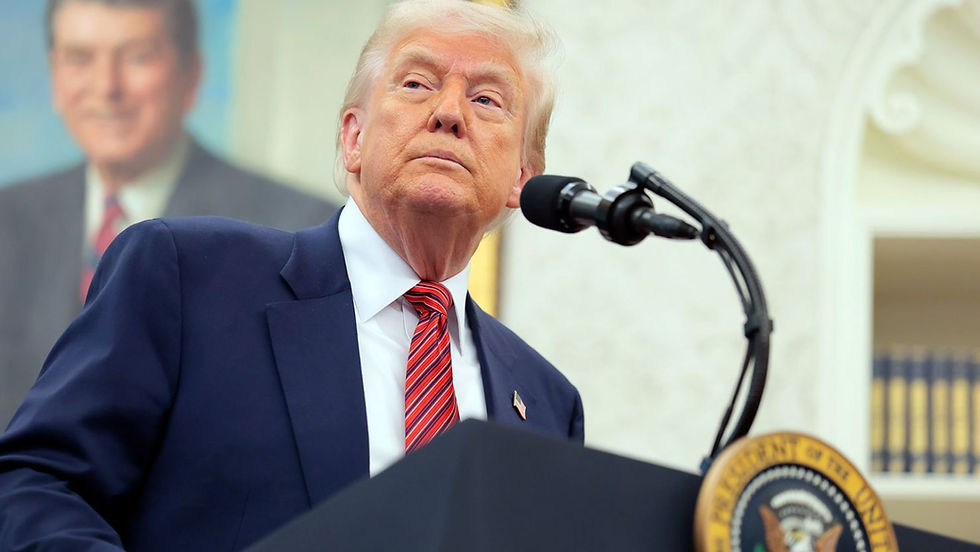
“Counting illegal aliens in the Census robs American citizens of representation and resources,” said Congresswoman Mary Miller (R-IL).
President Donald Trump has issued a directive calling on the Department of Commerce to initiate work immediately on a new census—distinct from the standard count every ten years—that would exclude undocumented immigrants. The President framed the initiative as a step toward a "highly accurate" count, grounded in "modern day facts and figures" and informed by data from the 2024 presidential election.
“People who are in our Country illegally WILL NOT BE COUNTED IN THE CENSUS,” the President wrote in a Truth Social post.
Mid-decade censuses are rare and typically cannot proceed unless explicitly authorized by Congress. It is true that the Census of Governments and the Economic Census is regularly conducted every five years; however, these are not full population censuses; they are focused on economic data and government structure. The last time Congress authorized a special population census was in 1975, which was conducted as part of a limited test.
Given the half-century gap, supporters argue this effort is long overdue. Until now, Supreme Court precedent has required counting “all persons” for apportionment purposes, regardless of citizenship or immigration status. Barring any overt partisan objective, there is a genuine, pragmatic need for this information, as existing methodology does not precisely or completely account for citizenship status. Of course, estimates exist—but they are not based on a direct citizenship question and carry a meaningful margin of error.
“Most Americans would be surprised to learn that states with more illegal immigrants are awarded greater representation in Congress… Addressing this perverse feature… needs to be part of any discussion about redistricting reform going forward,” said Rep. Kevin Kiley (R‑CA).
Rep. Mary Miller (R-IL) argued the memorandum is “simply common sense” in a recent Twitter/X post: “Counting illegal aliens in the Census robs American citizens of representation and resources. Thank you, President Trump, for putting an end to this insanity!”
Conversely, critics argue that any effort to exclude illegal immigrants from a national census would be “racist” and “xenophobic,” further contributing to minority groups’ fear and distrust of the federal government.
“Counting every person in our country through the Census is a principle so foundational that it is written into our Constitution,” California Governor Newsom (D) said in a statement. “This latest action by the administration to exclude undocumented immigrants when determining representation in Congress, rooted in racism and xenophobia, is a blatant attack on our institutions and our neighbors.”
“[The census] would be a dream come true for Donald Trump because he doesn’t think that any of these people count in life anyway,” said Congresswoman Anna Eshoo (D-CA). “This is clearly a move that is unconstitutional. And I think the president, frankly, is throwing red meat to his base.”
If this new census is conducted, it would likely almost assuredly result in lower population totals for certain states where undocumented populations are sizable—such as California, Texas, and New York—than what was previously reported in the decennial count. The President’s opponents fear this data could result in those states eventually losing seats in the House—and thus, political power—and, possibly, some federal resources.
But that argument is not entirely accurate. Mid‑decade censuses may indeed be allowed to distribute funding in‑between decennial counts, but not for reapportionment. Losing political power, however, is a legitimate fear—and it’s perhaps this reason above all that support or disapproval tends to fall on Party lines.
If that weren’t the case, one could expect to find at least a single Democrat in the House or Senate who did not uniformly reject the proposal. But, as of now, no known Democratic lawmakers at the federal level have publicly endorsed it—even those more apt to speak out against illegal immigration. Therefore, it is safe to say that the matter is not a question of constitutionality or humanitarian concerns—although opposition is frequently cloaked beneath these arguments—it’s a purely partisan affair.
Notably, there hasn’t been a legal challenge—even from the administration’s most ardent critics. Former California Attorney General Xavier Becerra, who sued President Trump over 100 times in his first term alone, said that his office does not have legal standing to bring forth a challenge.
“Simply because Donald Trump says things that are crazy or extreme doesn’t mean we can go to court,” Becerra said. “The moment they take action and that action would amount to a violation of the law, we now have standing.”
Others, like the ACLU have stated they’re already ready to fight: “We won’t hesitate to go back to court to protect representation for all communities,” said ACLU Voting Rights project director Sophia Lin Lakin.
Despite this, the administration remains undeterred.
“These actions are consistent with America’s democratic principles as outlined in the United States Constitution,” stated an unnamed White House official. “President Trump will never allow the erosion of our Nation’s democracy or the underrepresentation of lawful American citizens.”


Comments